
Highlights
Though short, the Ara Bicycle Path offers several scenic stops, curiosities, and architecture. Let’s go take a tour.

Eight Scenic Views
Incheon Metropolitan City designated eight views (수향8경) along the Ara Waterway. From west to east, these scenic landmarks are:
- 1st View — Yellow Sea (South Side of the Ara Waterway)
- 2nd View — Gyeongin Ara Passenger Terminal (South Side)
- 3rd View — Sicheon Park (both North and South Side)
- 4th View — Ara Falls (North Side)
- 5th View — Suhyangwon (North Side)
- 6th View — Duri Ecological Park (South Side)
- 7th View — Ara Gimpo Passenger Terminal (North Side)
- 8th View — Ara Han River Waterside (South Side)
Can you read Korean? Click here for a detailed map of the Ara Waterway.
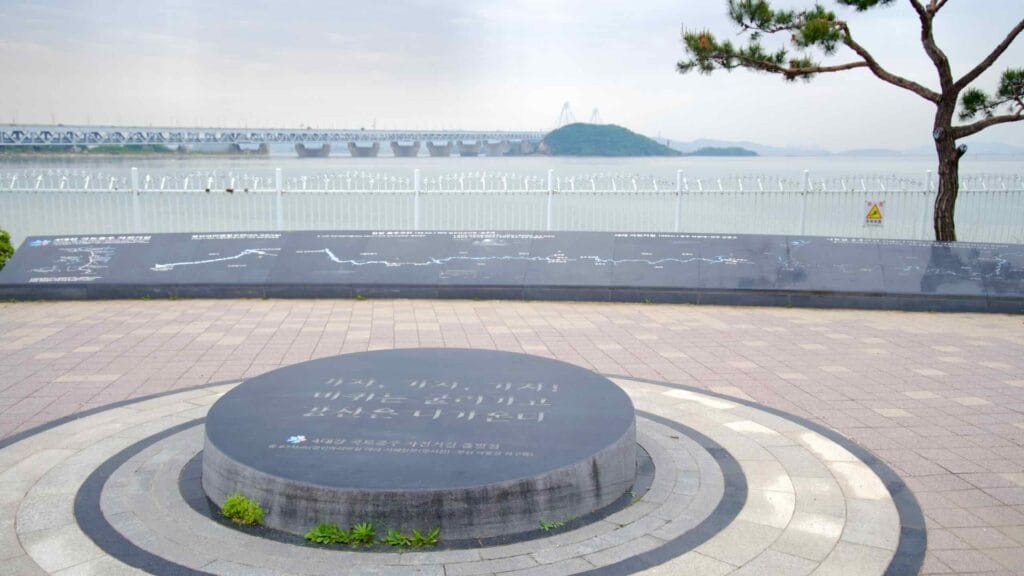
The Ara Bike Path begins on the edge of the Yellow Sea. Gaze westward. When the tide ebbs, you’ll see a vast muddy expanse surrounding Yeongjong Bridge and Yeongjong Island where Incheon International Airport hums.
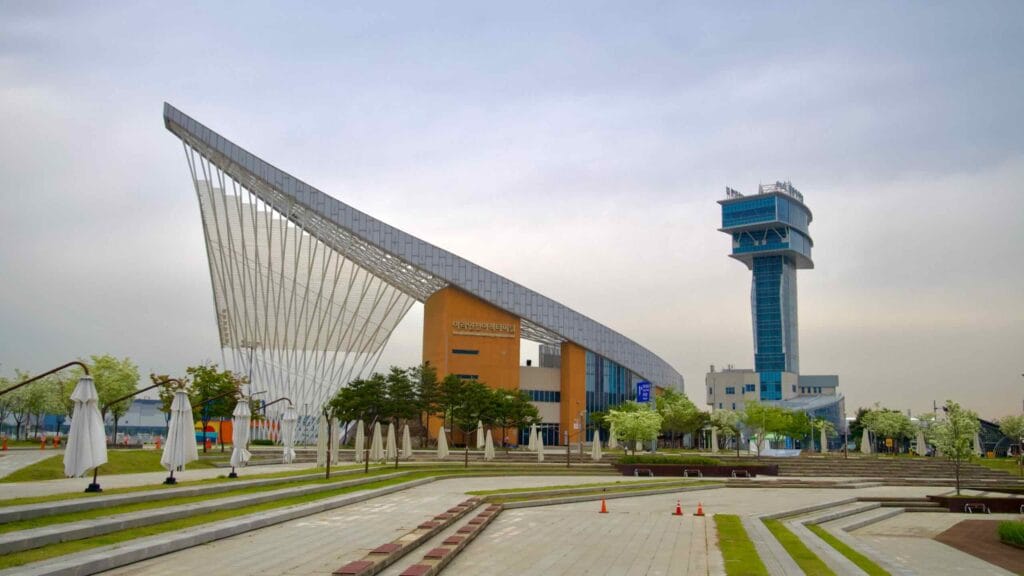
The Gyeongin Ara Passenger Terminal are a pair of buildings that hang near the start of the Ara Bike Path, where the Ara Waterway spills into the Yellow Sea. A sweeping white beam resembling a ship’s sail connects the structures.
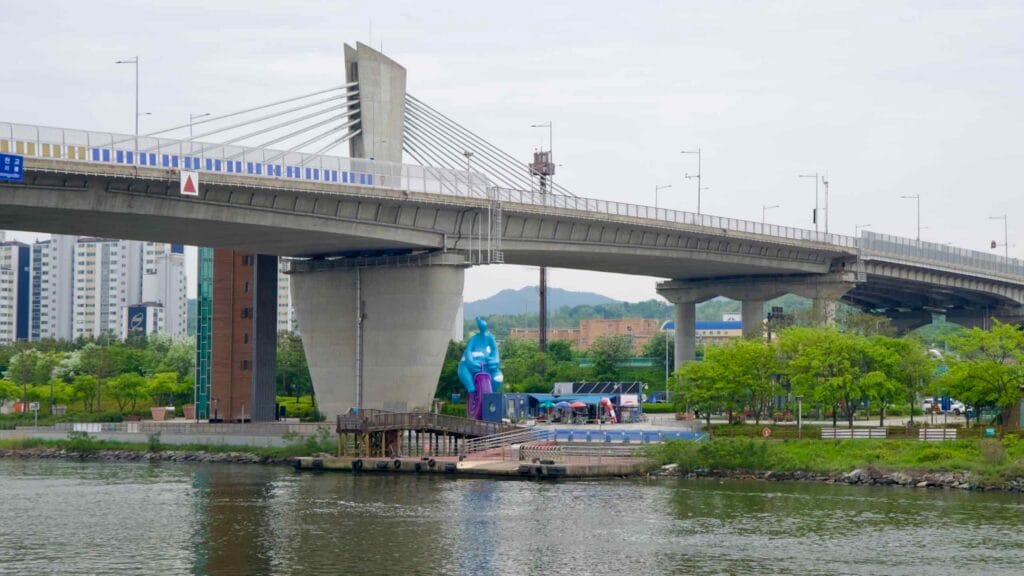
Sicheon Waterside Park sits a third of the way down the Ara Bike Path. The park straddles both sides of the Ara Waterway. Sicheon Bridge leaps over the canal and connects the park’s north and south areas.
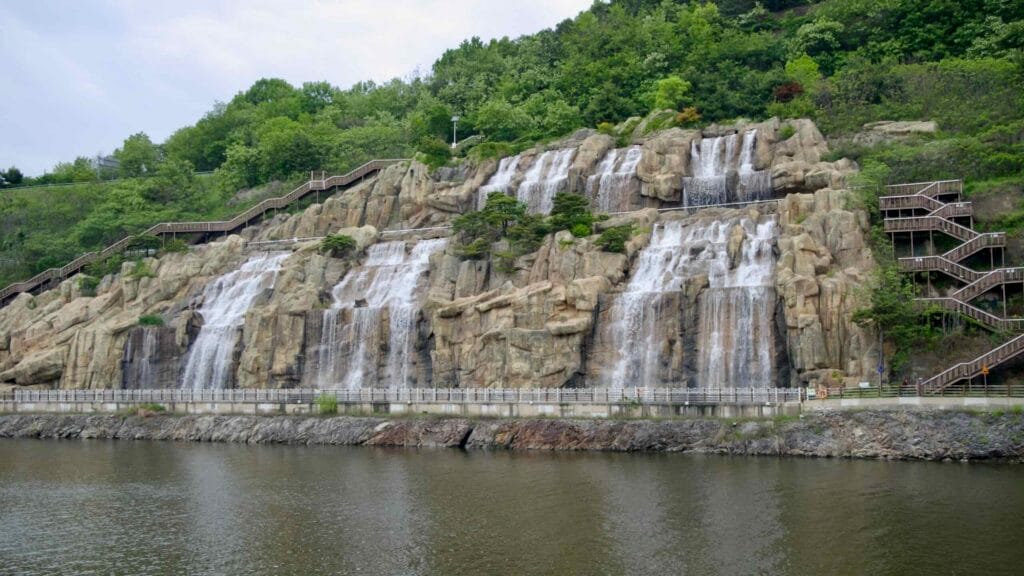
Ara Falls sits midway down Ara Bike Path. Designers modeled this 50-meter-tall, 150-meter-wide artificial waterfall after Inwang Jesaekdo, a Joseon Dynasty painting known as “After the Rain at Mount Inwang,” a mountain in downtown Seoul.
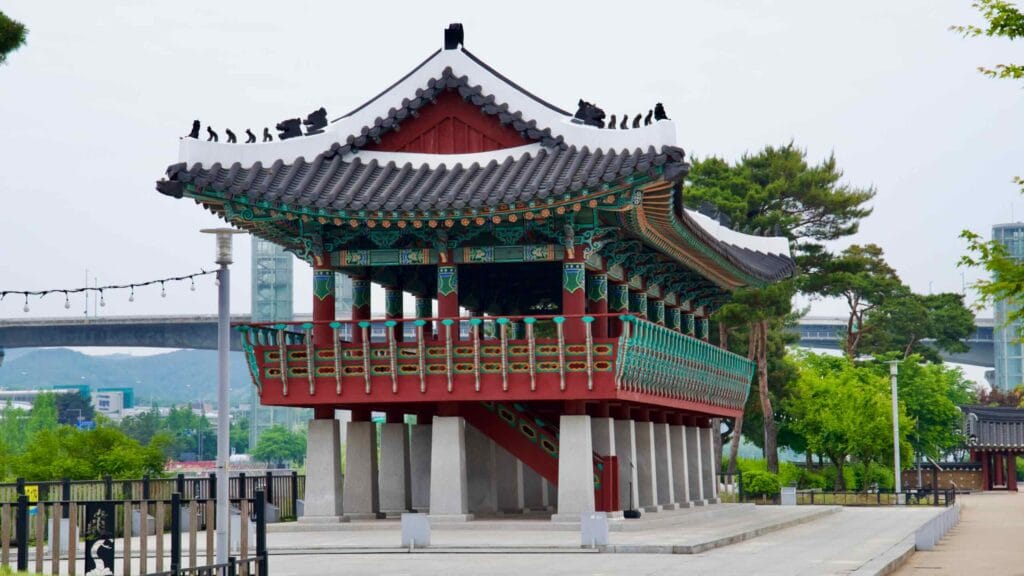
Suhyangwon is a pavilion complex sitting beside the Ara Waterway. Completed in 2012, designers built this public space together with the canal.
While constructed with modern tech, pavilions from the Joseon Dynasty (1392 ~ 1897) inspired the design of Suhyangwon’s structures.
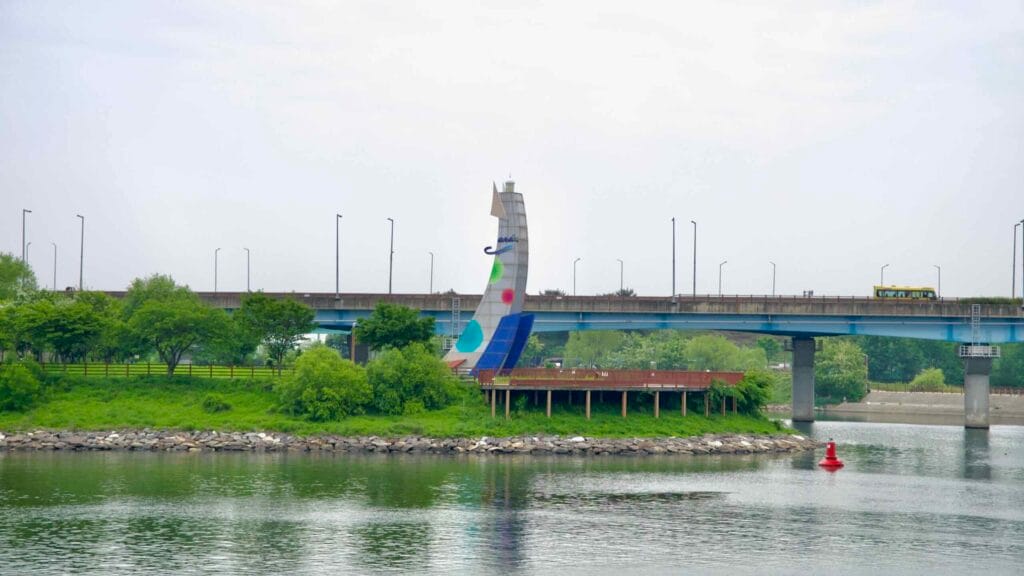
Duri Ecological Park sits at the Ara Waterway’s midpoint. A marshy expanse of green, the park lies at the intersection of the Ara Canal and Gulpo Stream, which flows north from downtown Incheon.
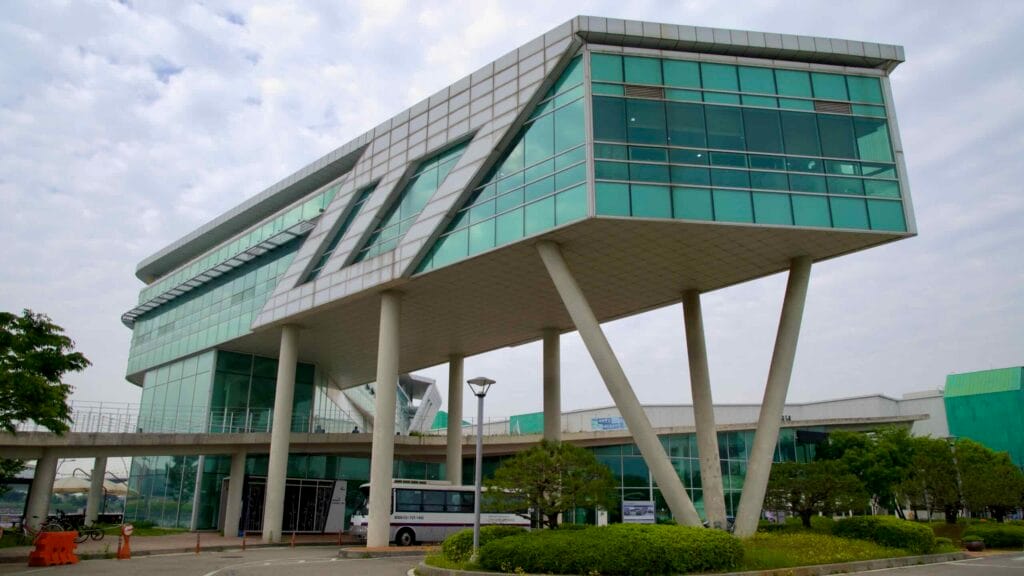
The Ara Gimpo Passenger Terminal is the Ara Waterway’s main cruise terminal and an architectural highlight. Named after Gimpo City, the terminal’s jagged, metal and glass structure rises along the northern banks of the canal near the Han River.
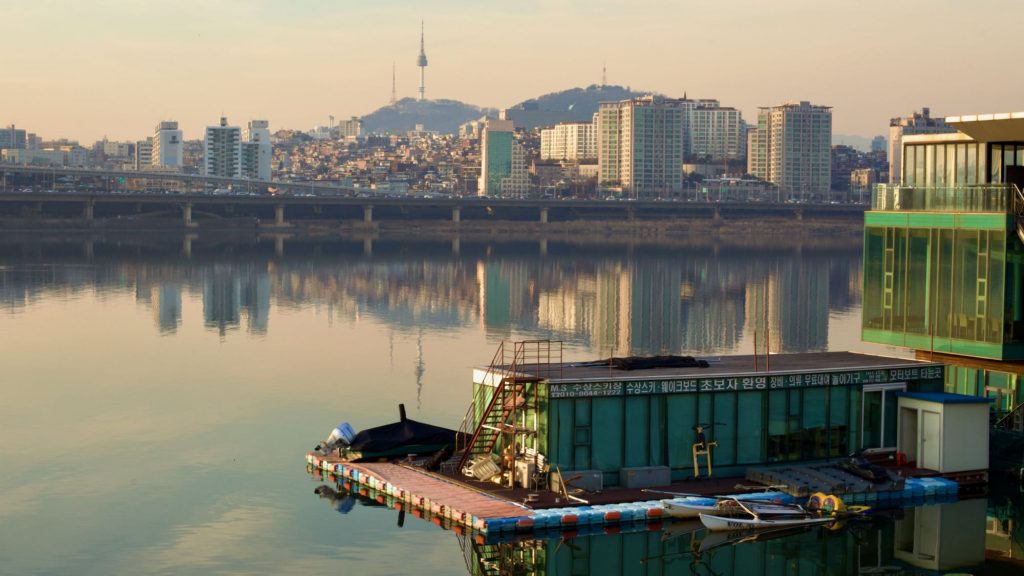
The Ara Waterway begins by diverting waters from the Han River (한강; map), Korea’s most important waterway, in western Seoul.
Since immemorial, Koreans believed that whoever controlled the Han River controlled Korea. Many kingdoms have kept their capital cities, including the Baekje Kingdom (백제; 18 BCE ~ 660 ACE), Joseon Dynasty (조선; 1392 ~ 1897), and today’s South Korea.
The Han River’s strategic position in the middle of the peninsula helped the kingdoms that occupied it.
- The Han River held endless acres of fertile farmland.
- It was an ancient highway that sent tax collectors deep into the kingdom and transported goods downriver to the capital.
- And the Han gave ships access to the Yellow Sea and trade routes with nearby China and Japan.
The eastern end of the Ara Bike Path offers a panoramic view of the Han River and a few notable highlights.
- Ara Hangang Lock (아라한강갑문; map) is a canal lock that raises and lowers ships between the Han River and the Ara Waterway.
- Gangseo Hangang Park (강서한강공원; map) is a protected ecological paradise and one of Seoul’s eleven Han River Parks. It supports thousands of species of flora and fauna.
- Two scenic bridges cross the Han River near the end of the Ara Canal:
- Haengju Bridge (행주대교; map; road view) and its cable-stayed towers.
- Banghwa Bridge (방화대교; map; road view) and its burnt orange trusses.